

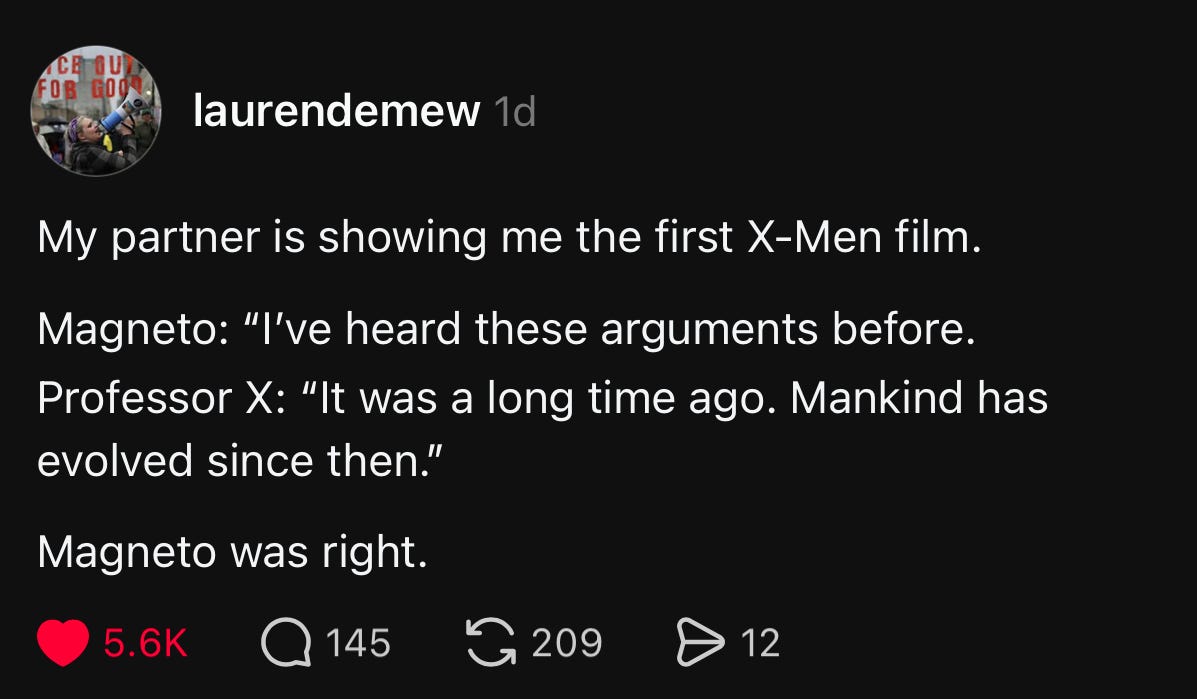
Sitting on my couch with a sick partner who had been begging me to watch the 2000 X-Men movie for weeks, I started some sarcastic meta commentary about how Magneto really was right. I tossed the thought onto Meta’s Threads platform expecting a few nerdy mutuals to laugh. Instead, it sparked real conversations between strangers.
As a self-described nerd, I’ve been generally aware of X-Men — mostly through early Tumblr gifs, essays, and OTP fan fiction of young Charles Xavier and Erik Lehnsherr. I’m not a celebrity person, but Michael Fassbender appears to have been engineered in a lab specifically to make me swoon. I didn’t realize the full political weight of the story until we watched X-Men ’97.
That thread got me thinking: we as a society love villains. Not all of them, but some really hit us at our core. One of the first lessons of writing a good villain is that they don’t see themselves as one. They believe they’re right. Magneto is a survivor of the Holocaust. He’s been through this before. He’s trying to make sure history doesn’t repeat itself, and he knows this will all end in bloodshed.

Watching his first scene in X-Men yesterday, I immediately empathized with his point of view. I’ve spent years circling the question of how people justify cruelty — how it becomes normal, how everyday citizens went on with their daily lives. Others “just following orders.” That question started for me as a kid. Like many American students who loved history class, the Holocaust was where it first became real.
Before I dive in, I want to acknowledge that I grew up on the usual sanitized American version of modern history. Americans are the good guys by default, the facts of the Black Freedom Movement get sanitized into the Civil Rights Movement, and then it’s summer break. The cycle continues.
When I was thirteen, my family took a trip to Washington, D.C., and I got to choose a few places to see. One of which was the United States Holocaust Museum. (Again, big nerd.)
At the end, I walked into the Hall of Remembrance — a bright white room lit by candles and an eternal flame. It was silent in a way that felt holy. I lit a tea candle. It felt like the only act of respect I could offer.
That moment stuck with me. Looking back, it’s probably when I first started seeing the costs of systems designed for cruelty— how survivors were forever changed. I didn’t understand it. I wouldn’t let it go until I did.
After the horrors of this administration and becoming an activist myself, it feels less fictional and more understandable now. I’m not acquiescing to a cruel ring of billionaire losers and their lackeys. A large percentage of the U.S. population agrees. Why would anyone expect Magneto to? That ship sailed long ago.
Once you’ve been a target, being told to “trust the system” isn’t reassuring. It’s hard to argue with anyone who’s already experienced dehumanization and is preparing for the worst. By comparison, Professor X seems naïve to believe a system where people openly campaign against your existence will somehow work itself out.
I’ve written before that there aren’t chosen ones. Change only happens when enough of us choose to act.
That’s why Magneto resonates right now. More people are waking up to what happens when systems fail and realizing, real quick, they may not be able to tolerate it at all. People feel the shift. What matters now is what they choose to do about it.